Farm

Bamboo Charcoal from India

biochar_image: 
Sornam Alagarsamy

we at Dr MGr Jatropha Biodiesel Project are now engajed in Jatropha oil manufacture
and also we plant bamboosa Vulgaris Bamboo
we have plans to convert all the Bamboo to Charcoal and supply to the world

Preparation Of Charcoal Using Agricultural Wastes

biochar_image: 

W. Bogale, Published in the Ethiopian Journal of Education and Sciences, Vol 5, No 1 (2010)

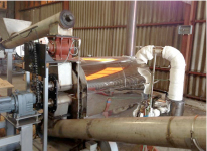
Mr. Bogale has been working in Ethiopia, and has developed a carbonizer that would allow a small land-holder to make charcoal out of agricultural residues and then dry and package that charcoal either for their own use, or for sale.

His paper has a very good table that helps make the case for the carbonizer, extruder system and it is available online through African Journals Online:
http://www.ajol.info/index.php/ejesc/article/view/56314

the abstract:
Abstract

Background: Wood charcoal has been the primary fuel for cooking in Ethiopia because it is cheap and easily avialable.However, using wood charcoal has consequences on health and pollution because of smoking. This study aims at providing a biomass as an alternative to wood charcoal using agricultural wastes (dry leaves, coffee husk, sugarcane trash, grass, etc) converted into charcoal briquettes to provide much needed source of cheap fuel that is cleaner in burning.
Methods: Simple extruder machine is used as die to make the briquette
charcoal.Moreover, an effective carbonizer to change the agricultural waste into charcoal and an effective stove to burn and use the charcoal for cooking is used.
Results: The manual extruder machine has a capacity of pressing 30kg/hr and the carbonizer converts 15kg of input agricultural wastes into 5kg of burned charcoal with in 25 minutes. The stove is effective so that three meals are cooked at a time using 100g briquette charcoal.
Conclusion: As compared to wood charcoal the charcoal briquette produced from agricultural wastes are economical, environmentally friendly, healthy (no smoke at all) and reduce impact of deforestation.

Biochar added to pasture soil decreases Nitrous Oxide Emissions

A study recently completed in New Zealand found that adding biochar to the soils of pastures where Cows (ruminants) were grazing sharply decreased the excess nitrous oxide from the cows urine. It appears that the biochar helps the soil absorb the extra gasses although long term testing of the effect of cow urine and pasture with biochar still needs to be done.

You can get the Full Report, or read the Abstract from the American Society of Agronomy web site:
https://www.agronomy.org/publications/jeq/abstracts/40/2/468

Biochar Incorporation into Pasture Soil Suppresses in situ Nitrous Oxide Emissions from Ruminant Urine Patches
by Arezoo Taghizadeh-Toosi,Tim J. Clougha, Leo M. Condronab, Robert R. Sherlocka, Craig R. Andersonb and Robin A. Craigiec
Published in the Journal of Environmental Quality Vol. 40 No. 2, p. 468-476

A summary is here: Can Biochar Help Suppress Greenhouse Gases?

2009 Biochar Trials in Hawaii

Josiah Hunt, Landscape Ecology July, 2010


Biochar Trials

In 2009 Landscape Ecology was awarded a grant to produce biochar amended compost and observe plant growth responses.

Syndicate content