Discoe

Ben Discoe

Biochar Retort vs Pit Trials, Ahualoa, Hawaii

Ben Discoe, July, 2010

I have now done tests with a pit, and contrasted with the retort.

For information on the retort see: http://terrapreta.bioenergylists.org/content/small-kilnretort-my-farm-ahualoa-hawaii and http://tech.groups.yahoo.com/group/biochar/message/11011

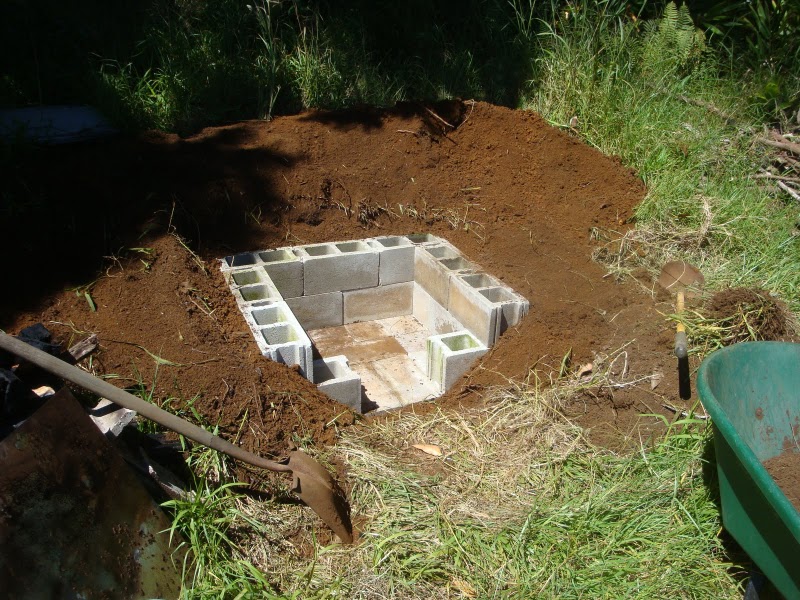
Since the retort had issues, i looked for a way to get larger capacity and fewer parts to wear out. The idea: a pit lined with concrete blocks, which can be covered with a piece of sheet metal and soil.


http://picasaweb.google.com/lh/photo/EvSIQ36xHXUHXEOCR25lMA?feat=directlink
http://picasaweb.google.com/lh/photo/81X5Ru49kaupg3ZTI10m7g?feat=directlink
http://picasaweb.google.com/lh/photo/pJk62bETLpcn1fkRt17Igg?feat=directlink

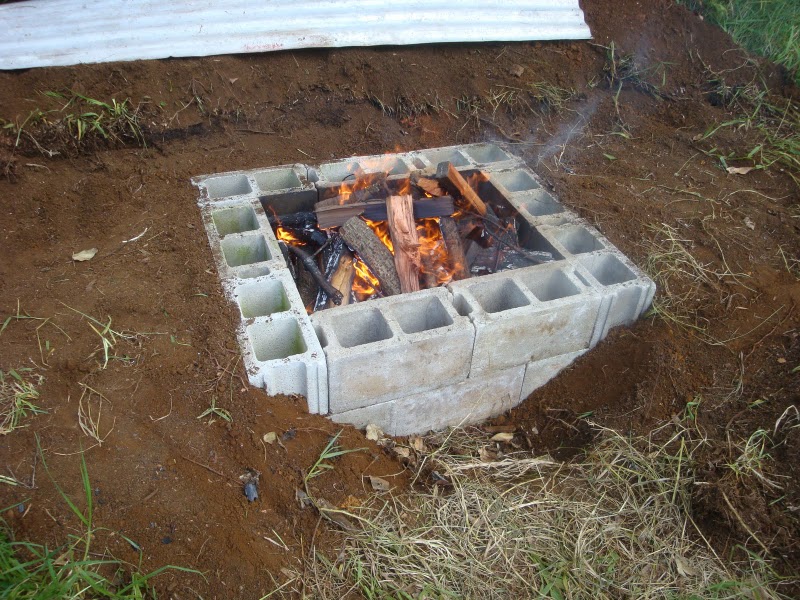
The blocks make a hard flat surface that's easy to unload, and cleanly separate the char from the soil. It works surprisingly well. As with jaywfitz's method (http://sensiblesimplicity.lefora.com/2010/04/28/biocharterra-pretta/#post13), wood is added gradually, the pile builds up and the bottom is oxygen-starved so it pyrolyses. When the pit is full, it is covered and left for a day to cool down. The next day, there is some incompletely-charred wood at the top of the pile, but this is not a problem, it's simply put aside and added to the next burn.

No water is needed to control or put out the fire.
Because temperature never gets that high at the walls, the blocks don't crack.
It's less picky about the size and shape of the wood, because an open fire is simpler than packing a retort.

It's difficult to judge how much ash is present (and hence the level of efficiency due to consumed feedstock), but it doesn't look like much ash at all. In fact it's possibly, even likely, more efficient than the retort, in which ~50% of the wood (which is outside the retort) is burned to ash.

A small pit of 16 x 24 x 32" (7.11 ft3, 53.2 gallons) yields around 16-17 gallons (loose chunks and fines) of char. It takes 33 CMU blocks to build. It took 40 minutes to load, fire and cover. The next day, it took 55 minutes to uncover, unload, and sift/sort the result using screen frames into 1/4"-, 1/4-1/2", and 1/2"+. These times, especially the unload/sorting, could definitely be improved by streamlining the process.

It should be possible to scale up significantly - e.g. a 24 x 32 x 48" pit (48 CMU blocks) should produce ~50 gallons per burn. I'll be trying that next.

-Ben
http://ahualoa.net/ag/notes_biochar.html

Biochar talk for coffee farmers

Ben Driscoe, June, 2010

I gave a 40-minute talk on biochar recently to the Kona Coffee Grower's Association (here on the island of Hawai'i).

10 minutes of it got uploaded: http://www.youtube.com/watch?v=42gr_1whjc8

It covers the basic carbon cycle, biochar's agricultural use, interaction with nutrients and microbes, reversing fossil fuel use, appropriate sources of renewable biomass.. my sources of information are, basically, this mailing list, and my own experiences making and using biochar.

I also gave the historial terra preta story, talked about various ways to make char, interaction with compost, how to charge with various nutrients including urine, and other stuff that didn't make it into the 10 minute clip.

-Ben
Also see Ben's super awesome Biochar Notes page: http://ahualoa.net/ag/notes_biochar.html

Biochar Retort vs Pit Trials, Ahualoa, Hawaii 3

Biochar Retort vs Pit Trials, Ahualoa, Hawaii 3

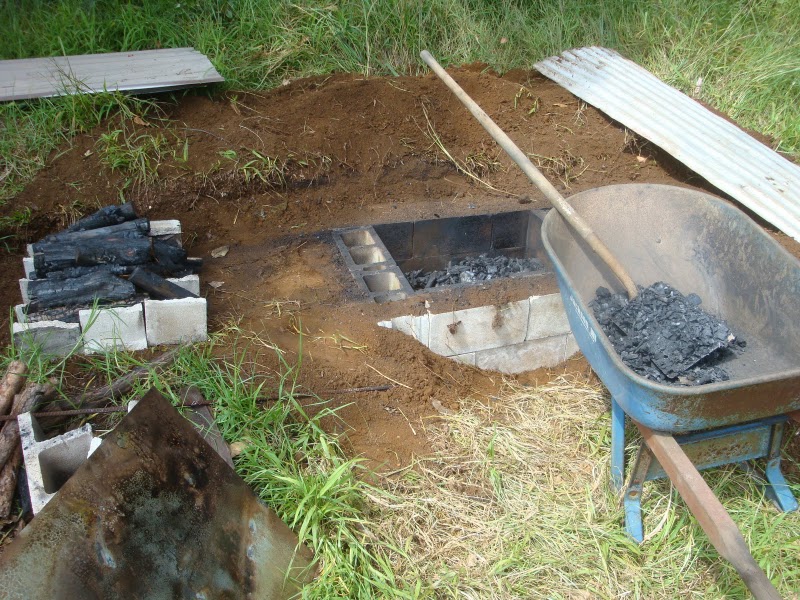
A few unburned logs go to the side, the rest goes into a wheelbarrow

For more detail see http://terrapreta.bioenergylists.org/node/1640

Biochar Retort vs Pit Trials, Ahualoa, Hawaii 2

Biochar Retort vs Pit Trials, Ahualoa, Hawaii 2

It's quick and simple to make a fire in the box

For details see: http://terrapreta.bioenergylists.org/node/1640

Biochar Retort vs Pit Trials, Ahualoa, Hawaii pit one

Biochar Retort vs Pit Trials, Ahualoa, Hawaii pit one

So, also trying a lower-tech solution: a simple pit, dug down and lined with blocks

For more detail: http://terrapreta.bioenergylists.org/node/1640

Syndicate content