Gill

Jock Gill Pellet Futures P.O. Box 3 Peacham, VT 05862 Live Green & Thrive! O: +1 (781) 396-0492 C: +1 (617) 449-8111 VT: (802) 613-1444

iCan D with vortex fins

biochar_image: 

Jock Gill, Vermont, 2011

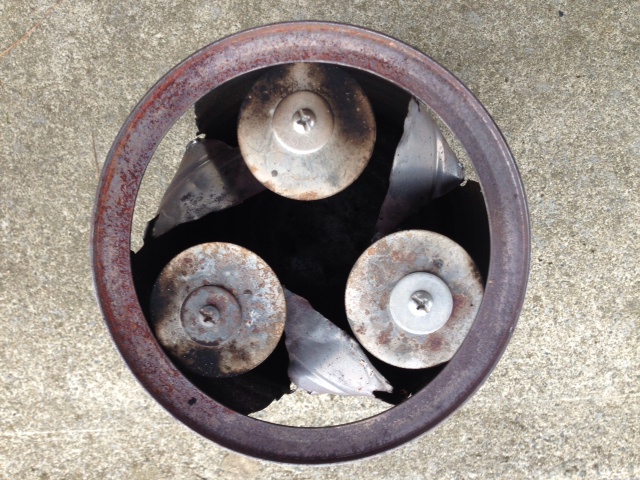
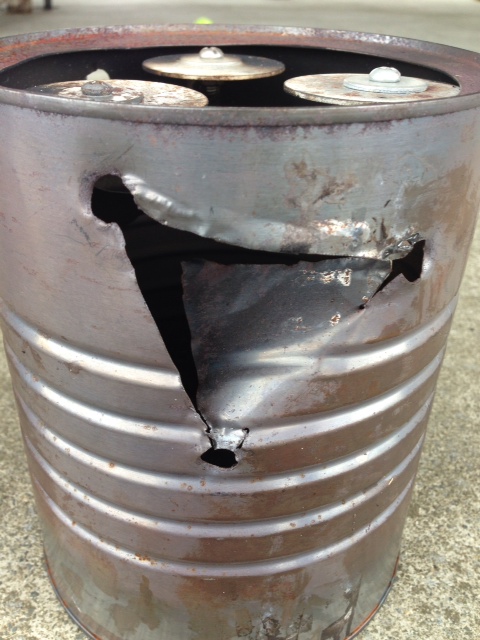
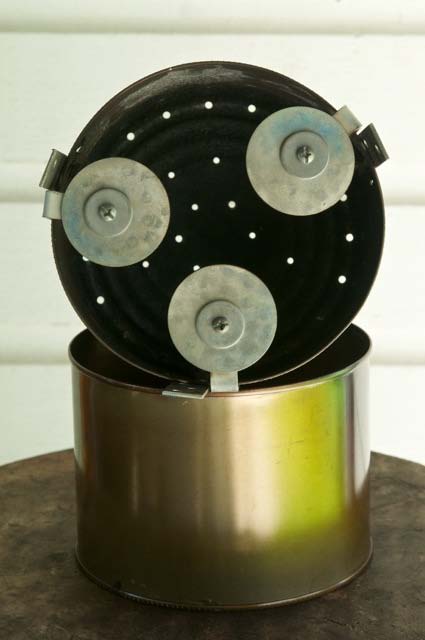
Jock's new TLUD Design. It has a passing similarity to Lanny Henson's Sidewinder, but instead of 4 symettrical slits, to provide the 'vortex' at the heart of the cooker. The iCan D uses only three secondary air apertures for maximum turbulence and asymmetry. It also uses a more triangular cut arranged such that the resulting tab is at 45 degrees and can, when folded into the can, act as both a vortex generator and a concentrator.

Currently I have only tested the mid-sized coffee can unit with 142 grams of fuel. This gives me a runtime of about 27 minutes -- start to flame out. It has yielded 21.8%% biochar as a percent of weight of fuel -- soft wood pellets.

It gets good results when loaded with 25% of the capacity of the can - in this case about 142 grams of wood pellets. Run time: 27 minutes. Smoke gone in well under two minutes. Biochar was very clean, 100% charred fuel with no floaters in a water quench. Minimal ash. Biochar harvest was 21.8% of the weight of the starting fuel load. Only minimal soot in the stack gases for about 3 minutes at the peak period.

The three combined vortex generator / concentrator tabs are at 45 degrees -- half way between maximum draft and maximum concentrator effect.

So far, for a naturally aspirated TLUD, this looks like a good balance between: 1] thermal energy production; 2] clean stack gases; and 3] max quality & amount of biochar harvested.

Larger Unit Results

Tomorrow, I will have a larger unit of the same design, but made from a 3 lbs Costco coffee can. I will give it a number of tests, including boiling water, and will pass these along to you. With some photos, if the weather is not too nasty. Otherwise, photos after the hurricane has passed us by.

Results for water boiling test #2 - with the Weber unit in place from the start.

Ambient temp: 17.2 C / 63 F

Amount of water: 750 ml

Boiled in 20 minutes.

Continued to boil for 29 minutes

Peak boiling: 43 - 47 minutes

Evaporated: 250 ML

Run time: 49:30

Smoke gone in 90 seconds

Biochar harvest: 127 g = 23% Passed all 7 tests.

By watching the boiling water it was very easy to see the variations in thermal energy released by the pyrolysis over time. Interesting visualization of the non-linear nature of the process.

I have attached two photos. More details on the iCan D design if you want them. Just ask. OK!

Cheers,

Jock

Jock Gill
PhotoPyroWorks
P.O. Box 3
Peacham, VT 05862
Carbon Negative Solutions
(G) (802) 503-1258

"Photosynthesis converts atmospheric CO2 into organic carbon which is 50% of all biomass. With pyrolysis, we can create carbon negative energy as we harvest carbon in the biomass for many beneficial uses."

The little teaching iCan that could

Jock Gill, April 2011
Peacham, Vermont, usa

For more about making the iCan stoves see: The Peacham iCan TLUD instructions on the Stove site
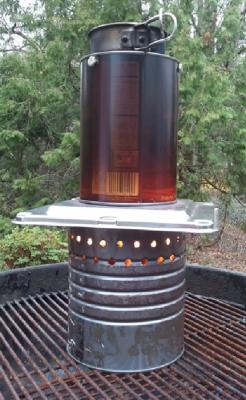

My little iCan made from a 3 lbs Costco coffee can boiled 1.75 liters of water in 42 minutes this afternoon. Ambient temp was 47 [8.33C]. This was done in 5 batches averaging 350 ml each. A very clean burn. Some soot at the start of each batch when the water was cold. Just a soon as the water in the cup warmed up a bit, the soot stopped.

Of course I also made some biochar as well.

Fuel was a good quality wood pellet. Cost of fuel: about 17 cents assuming pellets at $230 per ton. They can be bought for a good deal less, but I am using a higher number to be safe.

Cost per liter boiled: ~ 7.4 cents, allowing 4 cents as the value of the biochar captured at the rate of 17.5% of the dry weight of the fuel.
Total run time was 49 minutes. The first 2 minutes were allowed to burn with no load, ie an unobstructed stack. This burned off the alcohol starter. Boiled water for the next 42 minutes. Last 5 minutes were at the tail end of the energy curve and only warmed the water in the cup, but the water did not boil. With a bit more fuel I could have finished of another 350 ml of water.

In a professionally designed stove, I would expect better numbers -- of course! But, for a simple educational tool costing nothing or very little, I am pretty happy with these results.


Almost boiling. I timed each "boil" until a full rolling boil was achieved.

I wonder how this tacks up against other test results?

Cheers,

Jock

Don't Barbecue - Char-BQ!

Jock Gill, Summer 2010!!

See the attached pdf file for printable Char-B-Que Instructions in Gorgeous Full Color Detail!

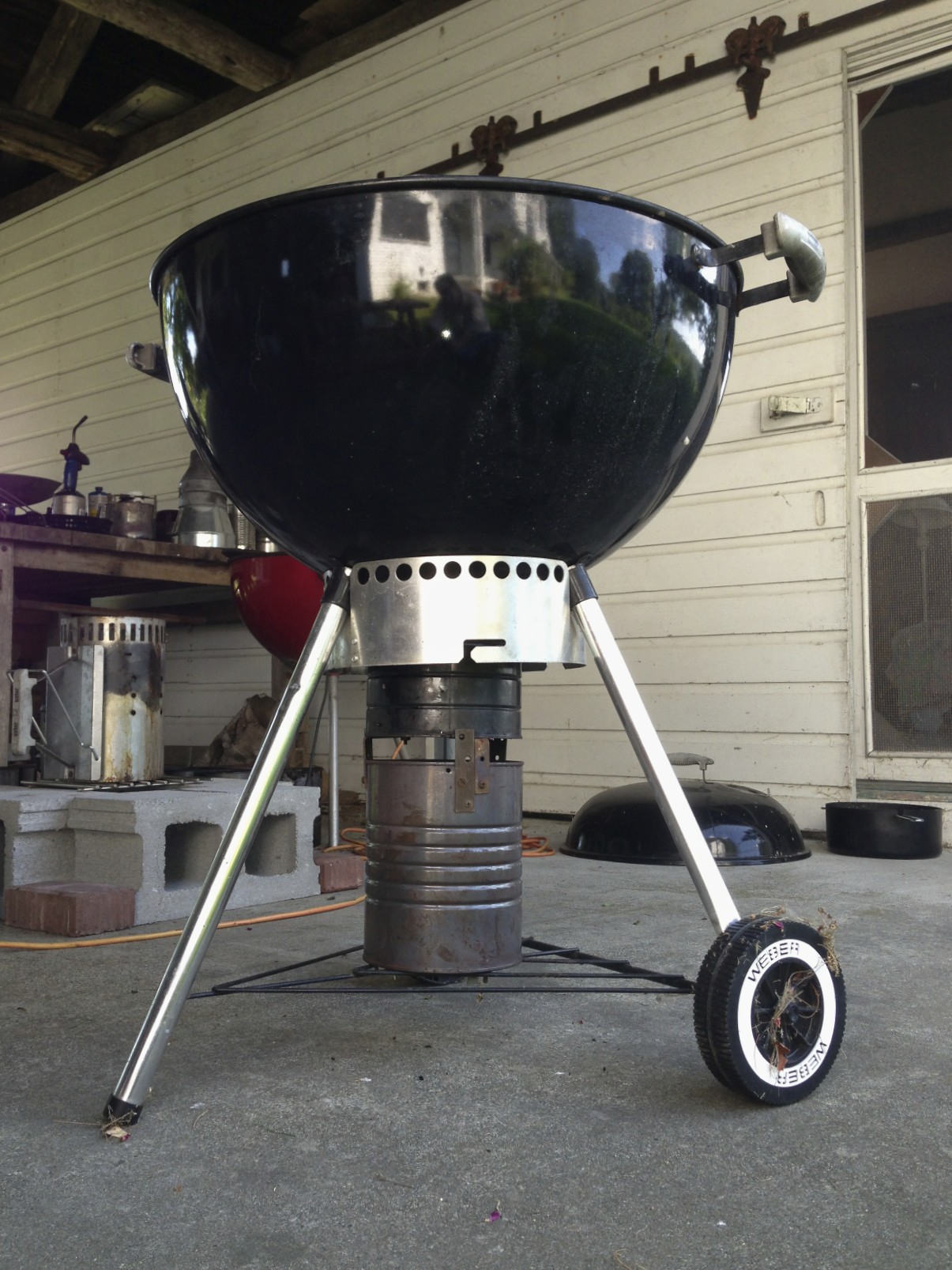
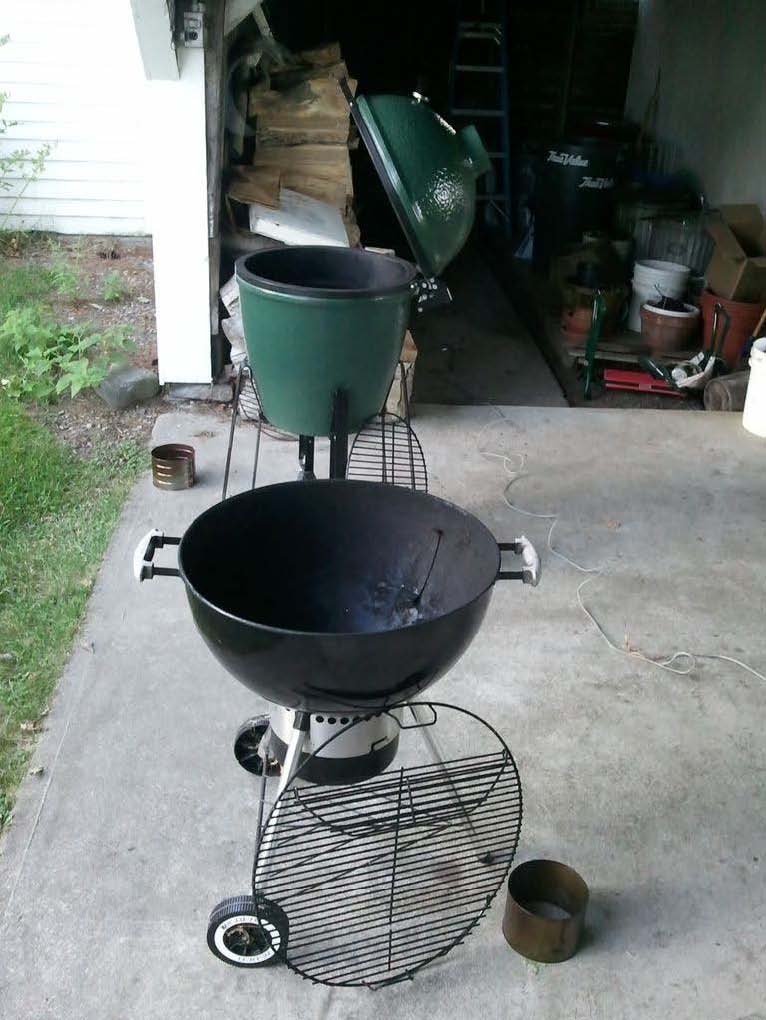
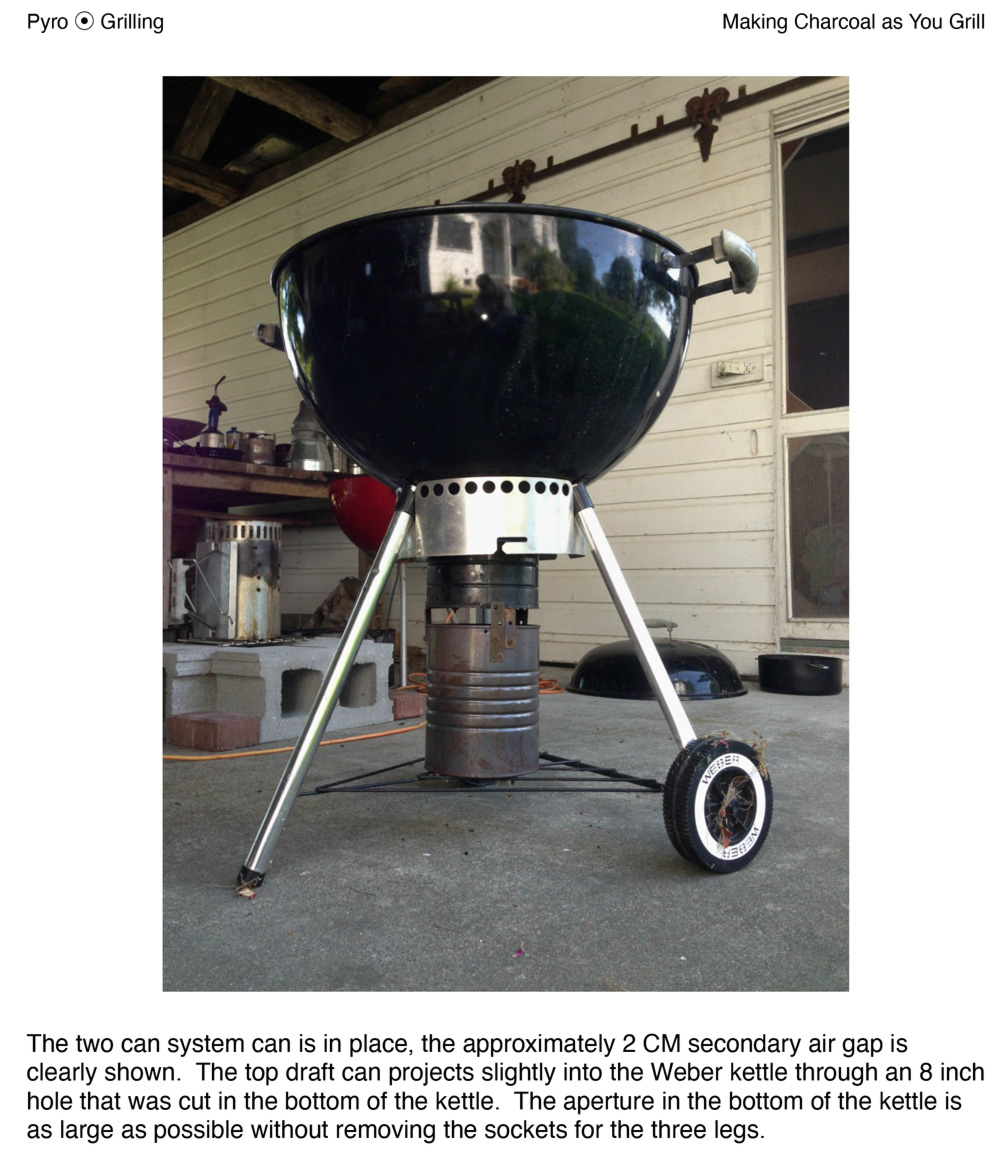
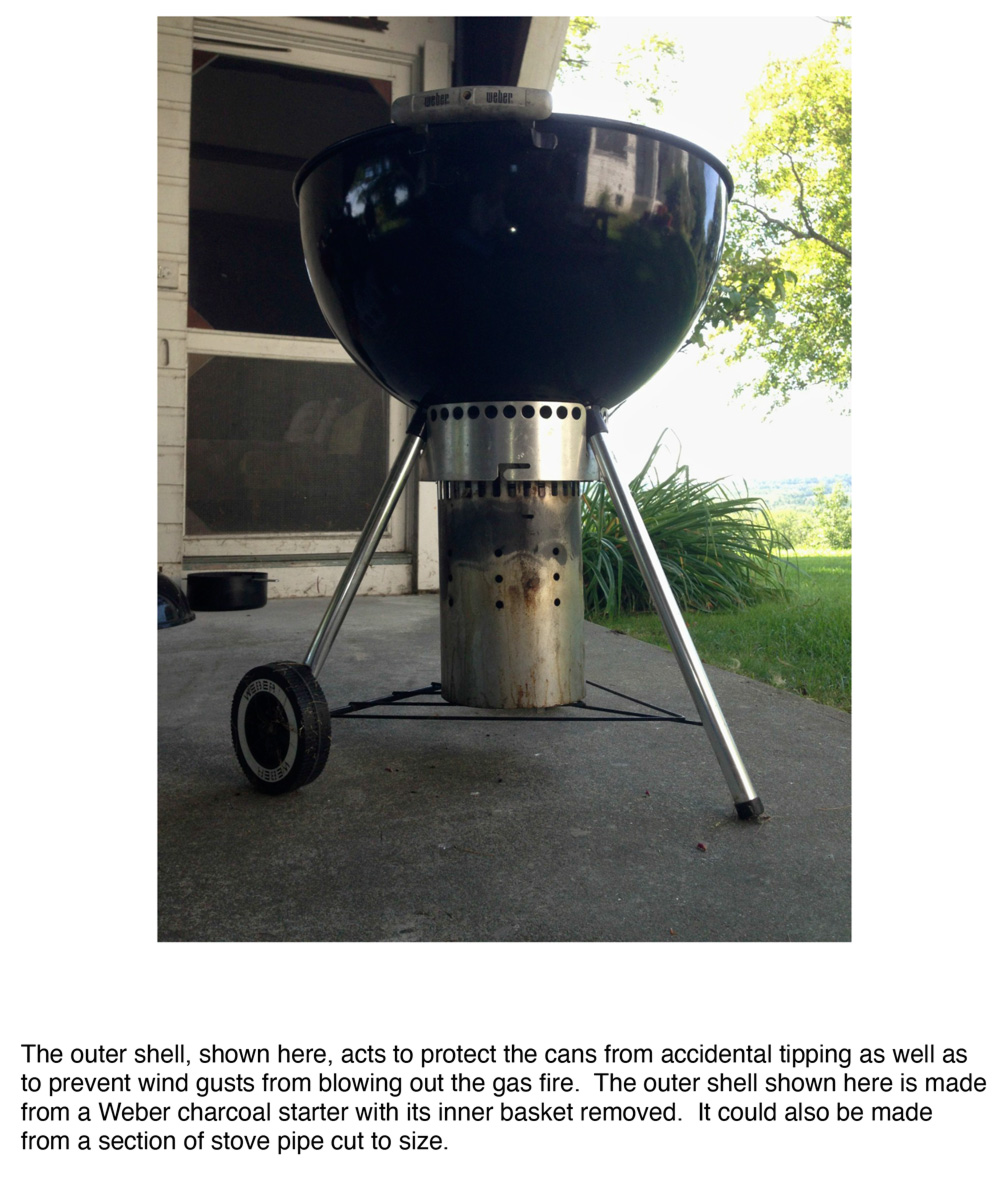
Basic Elements -- these are the elements required to convert a Weber unit to a carbon
negative Char-B-Que.
The B stands for Biochar. Total cost: $0.00
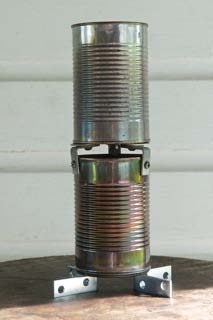
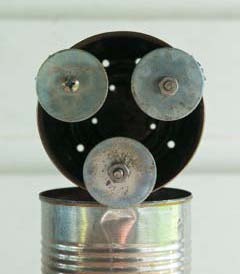
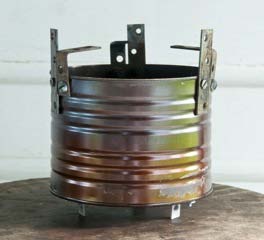
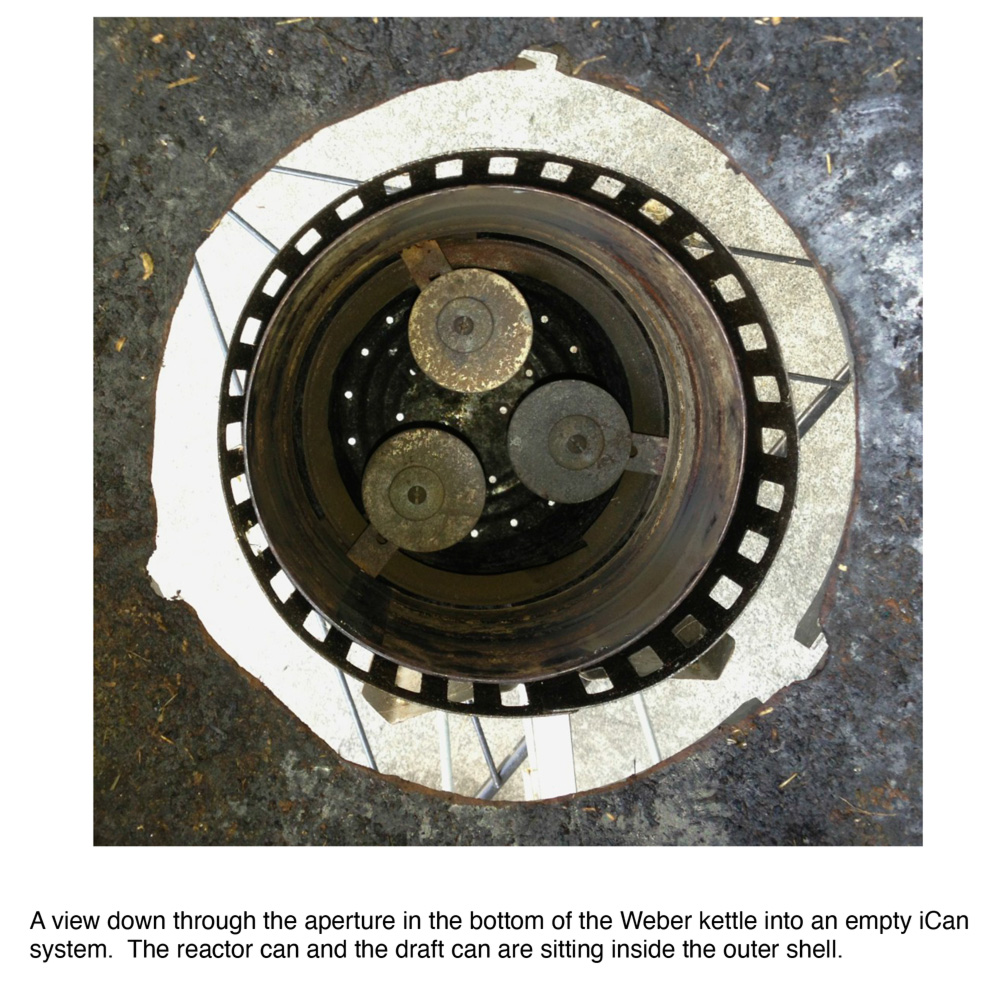
two cans -- these will be turned into iCan TLUD stove units
For more pictures of other experiments: http://www.flickr.com/photos/jockgill/

Hint: Measure the circumference of the can. Divide that by the number of holes you
want to have in your design. Use that result as the distance between hole centers.
Mark the hole centers as per the above and then make your holes.

Hint: Always make small pilot hole first and then work your way up to bigger and bigger
holes made with larger and larger tools. A set of graduated nails and spikes works
great. When in doubt, start with fewer and smaller holes. In general, primary air holes
will be smaller and secondary air holes will be much larger. The number of holes you
use and their sizes, and locations, has to be tuned for draft conditions, fuel type, fuel
form factor, and fuel size.

Perfect Char-B-Que Chicken. Juicy. Tender. No smokey taste. And no burned bits at all.Skin was also very crispy.
Cooking time: about 45 minutes. The right iCan had more primary air holes, 21, and burned out at 40 minutes.
The left iCan was complete at 48 minutes. It had only 15 holes for primary air. Tuning is important.

Biochar from the wood pellets in the iCan TLUDs at the end of the Char-B-Que. The biochar, which will be mixed with compost and then added to gardens as a soil amendment is how carbon that was in the wood pellets is sequestered. The long term sequestering of the carbon from the biomass is what makes the Char-B-Que "Carbon Negative".

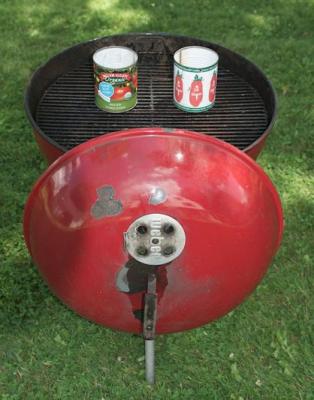
Cans burning: The cooking grate is now in place, with the iCans safely between the two grates.

Biochar Makes the 6 o'clock News, Newspaper and the Radio

Jock Gill, Northeast Biochar Assn, April, 2010

Vermont Public Radio Coverage
http://www.vpr.net/news_detail/87888/

A new biochar story in Seven Days, a Vermont newspaper:
Shelburne Farms Experiments with "Biochar" to Clean Water and Revitalize Soil
http://www.7dvt.com/2010shelburne-farms-experiments-biochar-clean-water-...

And:
Television coverage of Biochar Demonstration at Shelbourne Farms, Vermont

http://www.wcax.com/global/video.asp?clipId=4691863&autostart=true

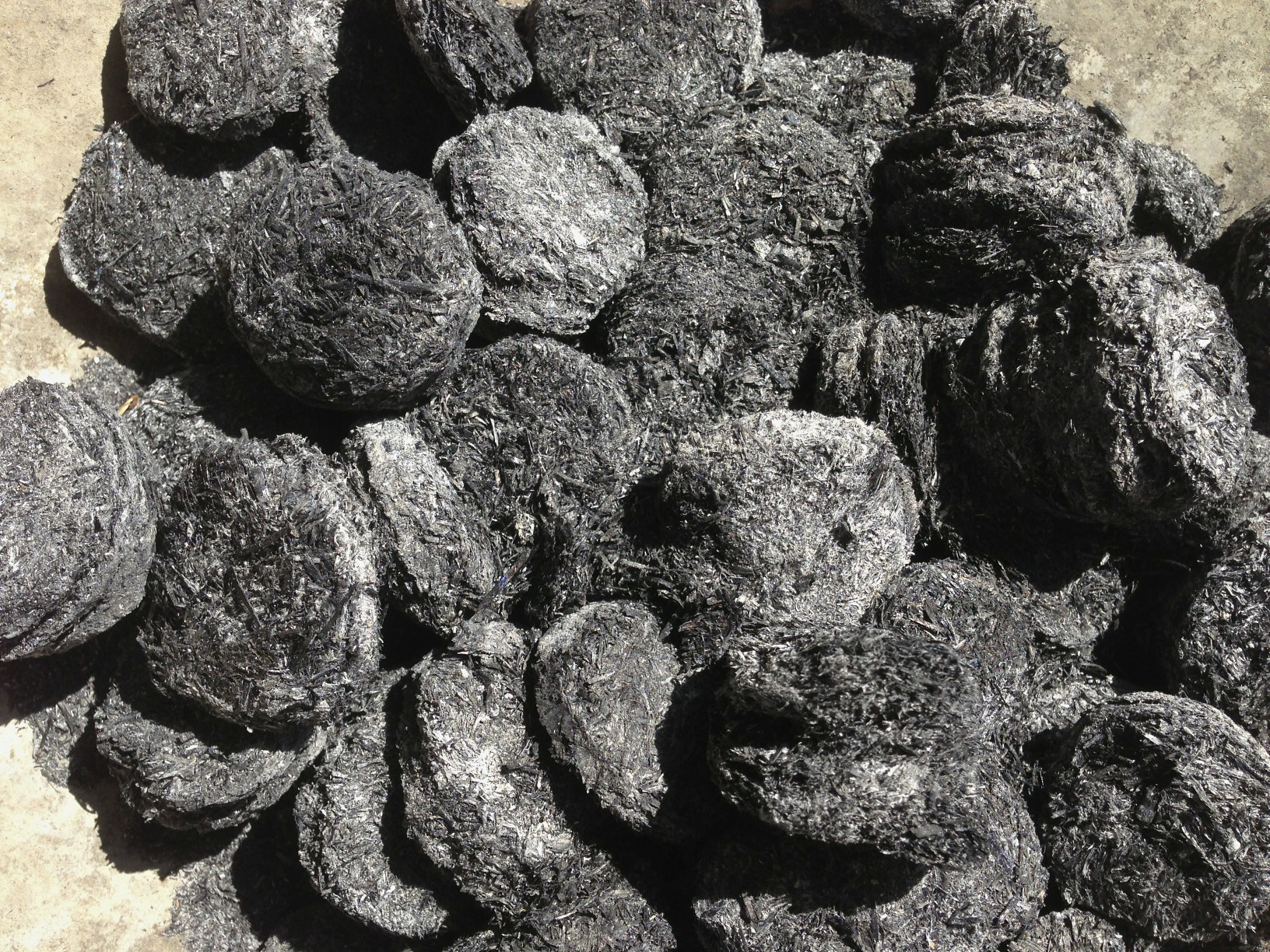
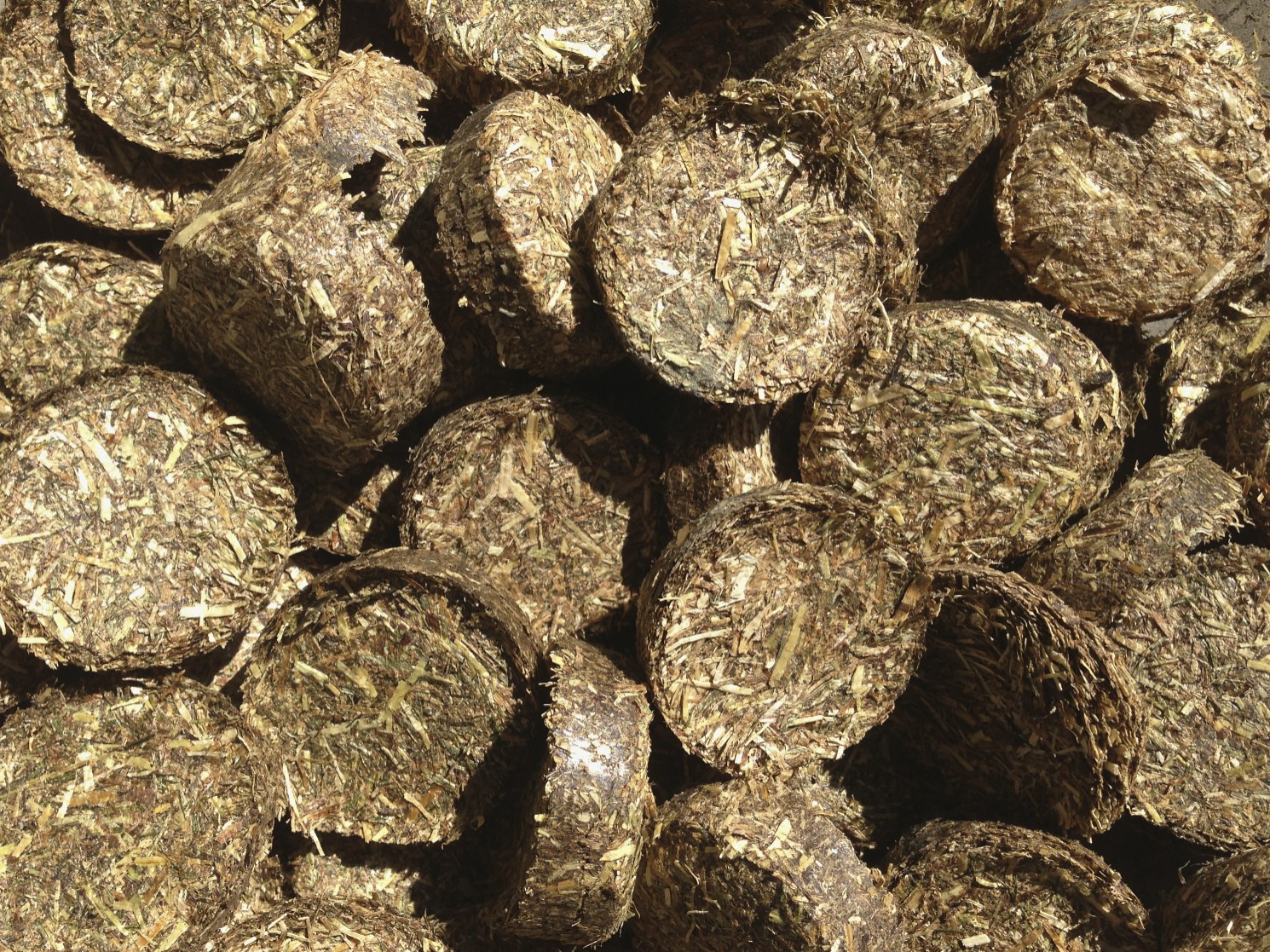
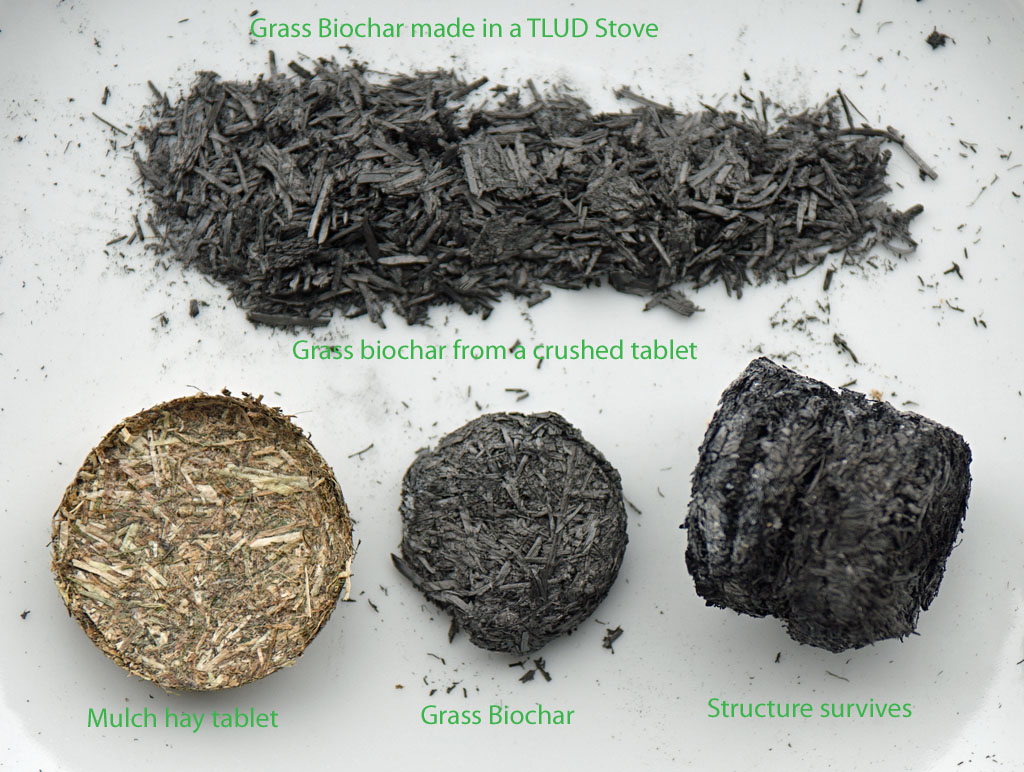
Grass Biochar made in the TLUD Stove

Grass Biochar made in the TLUD Stove

Jock Gill, January 2010

Grass Biochar made from a mulch hay tablet, and also from a crushed hay tablet.

See how the structure survives in the uncrushed tablet.

Two blog posts stimulated by the IBI Biochar Conference

 These two posts may be of interest.  In any case, all comments and suggestions are welcomed.

1. A Path Towards Carbon Negative Heating

http://www.greaterdemocracy.org/archives/806

and 

2. A Path Towards Low Carbon Agriculture

http://www.greaterdemocracy.org/archives/799

The second link lists 5 possible policy options, with a 6th in the comments, that might be considered. Note: none mentions biochar, but agreement with more than a few pretty much eliminates all but Biochar.  The idea is not to pick winners and losers, nor to tell elected officials what they have to do, and not to give policy staff one word they do not understand but gives them an excuse to walk away from the entire idea.

Regards,

Jock

Biochar Notes Links and Pointers

Biochar Notes Links and Pointers
Jock gill, Vermont

http://www.greaterdemocracy.org/archives/739

Here

Don't Barbecue - Char-BQ!

Syndicate content